

Bitget Theft: How AI Accelerated Cross-Chain Tracing
October 3, 2026
Technical incident analysis · Public evidence reviewed October 3, 2026
After the Bitget theft, investigators faced a familiar problem at an unfamiliar scale: funds were moving through bridges and other services faster than a person could reconcile each leg by hand. Chainalysis says its team used an internal AI platform to build case-specific tracing tools. One bridge-reconciliation task that would have taken more than 20 hours manually took under 10 minutes. Investigators still defined the logic and checked the results. Chainalysis’s investigation account
That is the clearest documented AI role in this case. It also raises two practical questions for future incidents: could similar correlation help teams spot a dangerous sequence earlier, and could it help responders share reliable leads faster? The first is a design opportunity, not a claim that AI prevented this theft.
Incident context
Bitget says unauthorized transfers began at 18:31 UTC on September 24, 2026. At 19:05 UTC, its reconciliation system detected a discrepancy and withdrawals were blocked. The exchange later estimated the loss at approximately $388 million. Its preliminary account points to a possible third-party security-product compromise and privileged-credential abuse. Bitget’s timeline Bitget’s fund-tracing update
Investigations by Mandiant and SlowMist linked the unauthorized wallet access to compromised third-party security products. SlowMist also described a customized withdrawal tool. These facts explain why identity, wallet commands, and on-chain movements matter to the response; they do not establish that the attackers used AI. Bitget’s investigation update SlowMist’s report
AI in the investigation: reconstructing the cross-chain trail
A bridge deposit on one chain and its payout on another do not arrive as a single, labeled transaction. Investigators have to compare amounts, timing, protocol behavior, address histories, and other evidence while funds continue to move. Repeating that work across many routes is slow.
Chainalysis reports using its internal agentic platform to create custom automations for this investigation, connecting fragmented activity and matching deposits to payouts. Its reported reduction from more than 20 hours to under 10 minutes concerns one bridge-reconciliation task. It is a useful account of what the team achieved, not an independent benchmark for the entire investigation. Chainalysis’s investigation account
The useful pattern here is not an AI system naming the thief. It is a tool surfacing a possible connection, with enough supporting transactions for an analyst to judge whether the lead is worth pursuing. Source records and confidence remain part of the finding, so a tentative match does not quietly turn into an attribution claim.
AI’s potential role in earlier detection
There were 34 minutes between the first reported unauthorized transfer and Bitget’s withdrawal block. That interval does not prove that an AI model would have detected or stopped the attack. It does suggest a testable question: could a system correlate unusual privileged access, changes in a security-product management plane, wallet commands, and a burst of withdrawals before reconciliation finds the balance gap?
Each signal might be ambiguous alone. Together, their order and relationships could justify a closer look or meet the conditions of an existing transaction rule. Whether this works in practice depends on timely, trustworthy telemetry, tests against earlier incidents, and an honest measure of false alarms. Missing events remain missing evidence, and withdrawal authority still belongs outside the model. The same separation between model advice and enforceable controls is explored in Production Guardrails for AI Agents.
AI’s potential role in response coordination
Bitget published a live tracking dashboard and an attacker-address API for other ecosystem participants. Those feeds give exchanges, custodians, issuers, and bridges something they can compare with their own exposure. Bitget’s tracing resources
An AI-assisted response workflow could summarize changes in those feeds, group related addresses, highlight the exposures that appear most urgent, and prepare a first draft of a partner notice. Those are possible uses, not documented Bitget deployments. Their value would depend on every alert remaining connected to its source, update time, confidence, and correction history. Without that context, a fast system can distribute a mistaken match as efficiently as a valid lead.
Responsibility boundaries in system design
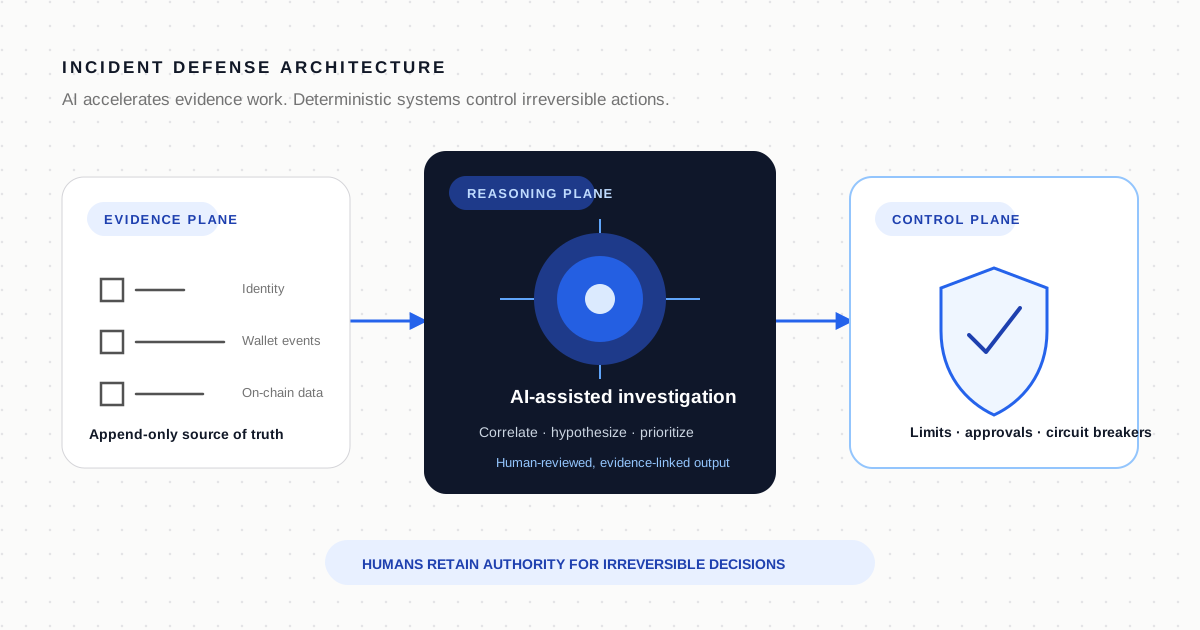
The incident points to three layers with different responsibilities.
The first is an evidence layer: identity events, administrative changes, wallet commands, policy decisions, signing requests, and on-chain transactions share consistent timestamps and correlation IDs. Its audit history sits beyond the reach of the systems under investigation, giving analysts a record they can trust.
Above that sits AI-assisted analysis. This is where models can assemble timelines, suggest cross-chain matches, connect weak signals, and help analysts decide where to look next. The distinction between a confirmed fact, a correlation, and a hypothesis stays visible because every conclusion remains linked to its source events.
The final layer is made up of transaction controls that do not depend on the model: limits, separation of duties, independent approval, delayed execution, and circuit breakers. A fallback path also matters, because containment cannot disappear when a model or vendor API is unavailable.
A production-readiness checklist can provide a useful structure for examining these boundaries before an incident. In an exercise, the revealing numbers are not limited to model response time; they also include how long the team takes to notice a problem, understand it, contain it, and correct a false lead.
The documented result here is faster investigative correlation in Chainalysis’s account. Earlier warning and smoother coordination are plausible applications to validate, not outcomes this incident has proved. The useful division of labor is simple: AI helps people find and connect evidence; independently enforced controls govern money and authority.